Macaron printer: how boutique patisseries personalize a French classic
Macarons are the premium niche where personalization is now the strongest selling argument. This guide explains how a macaron printer reshapes order flow and what to know before buying.

Macarons are the premium French niche where personalization has become the strongest selling argument. Weddings, corporate events, luxury gifting — buyers no longer accept six classic flavors in a plain box: every box has to look commissioned. This guide explains how a macaron printer reshapes order flow and what to know before buying.
How is printing on macarons different from a cake?
A macaron shell is small (35–50 mm diameter) and perfectly flat, and the surface is dry and smooth. That makes it technically easier to print on than a glazed cake — but it demands a different workflow. Instead of one print per 3–5 min., you print 20–40 macarons on a single tray at once. A standard A4 sheet fits 20–30 macaron shells depending on size, which turns a macaron printer into a batch tool rather than a single-piece tool.
What can you actually print on macarons?
- Corporate logos — wedding, christening and anniversary favors
- Monograms and initials — personalized guest boxes
- Full-color photographs — birthdays, anniversaries, bespoke gift packs
- Seasonal motifs — Christmas, Valentine's, Easter collections with no extra equipment
- Corporate branding — company colors and tagline for a full product shelf
The business math
A typical boutique macaron sells for €2–3 in Western Europe (€1.20–2.00 in the Baltics). A personalized 12-piece box retails for €25–40, which adds roughly €0.60–0.80 per piece in margin. On personalized batches the margin often doubles — because the customer is paying for the gift's finish, not the flavor. Printing cost: ~€0.15–0.30 per ten pieces using CMYK edible ink (€15 per 100 ml bottle).
How it fits into a working patisserie
A macaron printer is the least invasive piece of kit you can add — ~60×40 cm of bench space, standard outlet, USB or network. Workflow: 1) bake and cool the shells, 2) place them on a flat tray, 3) print using a saved PDF or PNG template, 4) finish with ganache and assemble. The whole personalization step takes 5–8 min. for a 30-shell batch.
Specialized or universal?
- If you only print on macarons and other flat dry goods (cookies, gingerbread) — a dedicated macaron printer is enough
- If you also want to print on glazed cakes — a universal confectionery printer adds 30–50% more applications
- If trays will be heavily loaded (60+ shells per run) — look for an A3 model with a wider print bed
- Check how your most-used shell colors render — pastel shells print richer than dark shells
Related: Which food printer to choose — 2026 comparison • Food printer business — 30-day launch plan • Food printer 2026 — complete guide
Related products

Macaron Printer
Take your macaron production to the next level — every macaron can carry a unique logo, photo or festive motif, printed with millimetre precision.
View productReady to start printing yourself?
JetLT food printer — from €1,600. 12-month warranty and initial training included.
Blog

Food printer buyer's guide — 7 questions to ask before buying in 2026
Before you commit to a food printer, run through these seven concrete questions — surfaces, speed, inks, support, training, warranty and real payback. Specifics drawn from JetLT customer cases.
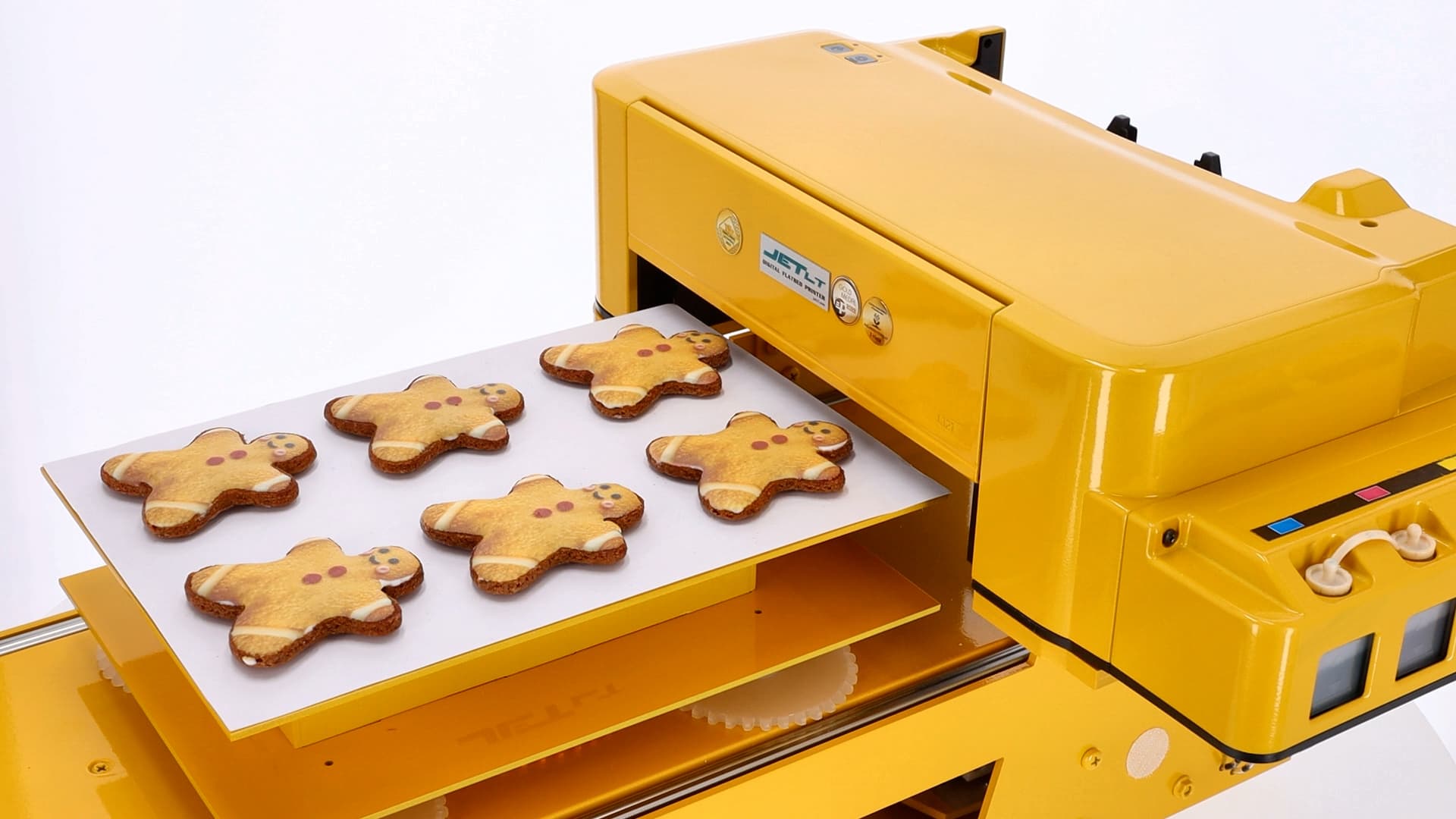
Gingerbread printing, preparing your bakery for the Christmas season
October–November is the right time for bakeries to prepare for Christmas-season orders. Personalized gingerbread with corporate logos, names or holiday motifs is becoming one of the biggest B2B sales categories. An edible inkjet printer lets you handle large batches (200–500 pcs per day) without manual decorator labor cost.